NIPT (Future Health)
A private nipt (future health) taken by an experienced phlebotomist at our Widnes or Crewe clinic and analysed by an accredited pathology laboratory. This test measures 8 biomarkers, listed in full below.
- Results turnaround
- 3–7 working days from the sample reaching the laboratory
- Sample type
- Single venous blood sample from mum's arm, from 10 weeks of pregnancy
- Biomarkers measured
- 8 included
How noninvasive prenatal testing (NIPT) works
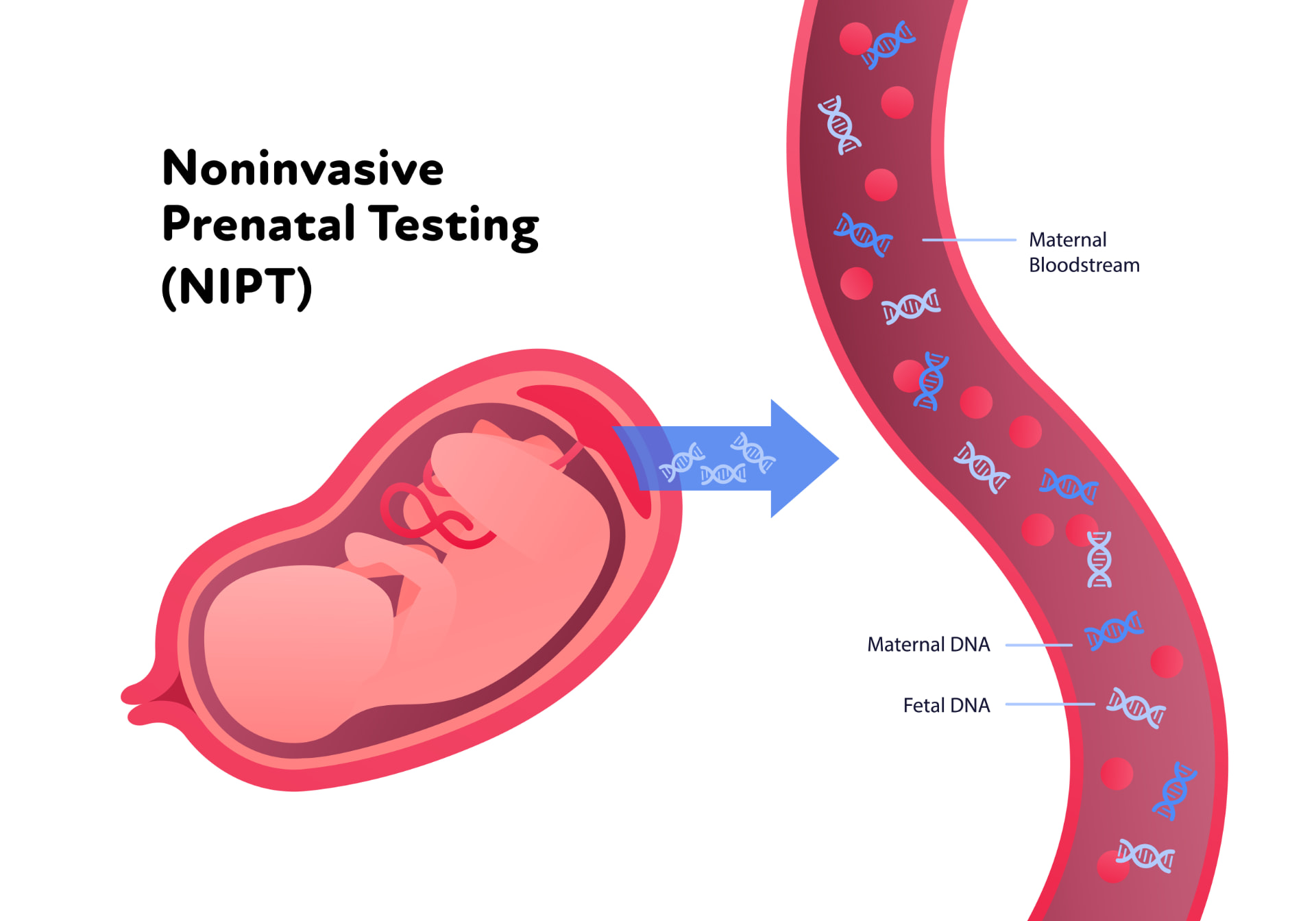
NIPT analyses the mix of maternal and fetal DNA naturally present in your bloodstream, screening for chromosomal conditions without any risk to your pregnancy.
- 1
Fetal DNA circulates in your bloodstream
Cell-free fetal DNA from the placenta joins your own DNA in the maternal circulation from early in pregnancy.
- 2
A single venous blood draw
No amniocentesis, no needle near the baby — just a standard blood sample taken by a qualified phlebotomist.
- 3
Chromosome screening in the laboratory
The lab separates and sequences the fetal DNA to screen for chromosomal conditions and, if you wish, reports fetal sex.
What this test measures
Every individual marker included in the nipt (future health), grouped by laboratory panel.
Common trisomies
- Down's syndrome (Trisomy 21) — chromosome 21
- Edwards' syndrome (Trisomy 18) — chromosome 18
- Patau's syndrome (Trisomy 13) — chromosome 13
Sex chromosomes (optional)
- Fetal sex — male (XY) / female (XX), optional
- Jacob's syndrome (XYY)
- Klinefelter syndrome (XXY)
- Triple X syndrome (XXX)
- Turner syndrome (monosomy X / XO)
Compare the three Future Health options
All three Future Health screens use the same single blood sample taken from mum's arm from 10 weeks of pregnancy. They differ only in how much of your baby's genome is screened.
| Screened for | NIPT | NIPT+ | NIPT+ Microdeletions |
|---|---|---|---|
| Common trisomies | |||
| Down's syndrome (Trisomy 21) | |||
| Edwards' syndrome (Trisomy 18) | |||
| Patau's syndrome (Trisomy 13) | |||
| Wider chromosome screening | |||
| All 22 autosomal chromosome pairs | |||
| Sex chromosomes (optional add-on) | |||
| Fetal sex — XX or XY | |||
| Sex chromosome aneuploidy (XO, XXX, XXY, XYY) | |||
| Microdeletion syndromes | |||
| 1p36 deletion syndrome | |||
| Wolf-Hirschhorn syndrome (4p16.3) | |||
| Cri-du-Chat syndrome (5p15) | |||
| Prader-Willi syndrome (15q11.2-q13) | |||
| Angelman syndrome (15q11.2-q13) | |||
| DiGeorge syndrome (22q11.2) | |||
The conditions screened
Trisomy 21 — Down's syndrome
Affects around 1 in 1,000 babies and can cause specific learning difficulties and physical differences. Every child is affected to a different degree.
Trisomy 18 — Edwards' syndrome
A serious condition affecting around 1 in 6,000 live births. Affected babies are often slow to develop and experience severe medical problems.
Trisomy 13 — Patau's syndrome
Affects around 1 in 5,000 births and causes severe physical and developmental difficulties; many pregnancies are sadly lost.
Why families choose this test
- A single blood draw, similar to a routine blood test
- Non-invasive and therefore safe for your baby
- Available from 10 weeks of pregnancy
- Results within 3–7 working days of laboratory receipt
- Option to determine your baby's sex and screen for X and Y chromosome aneuploidy
- Can incorporate the results of your NHS first trimester (combined) screening
- Complimentary genetic counselling service
- Whole genome sequencing on a CE-IVD marked, automated workflow
When we can't test
The screening is not suitable if any of the following apply:
- You have received an organ or bone marrow transplant
- You have had a transfusion of heterologous cells in the last 12 months, such as a white cell transfusion or stem cell therapy
- You have cancer
- You carry a chromosomal imbalance, such as an aneuploidy, chromosomal deletion or mosaicism
- Dichorionic twin pregnancies are eligible for standard trisomy 21, 18 and 13 screening only — sex chromosome screening and fetal sex are available for singleton and monochorionic twin pregnancies only
If you're unsure whether any of these apply to you, call us before booking and we'll talk it through.
Understanding your result
High chance
Your baby may have one of the conditions screened for. The nature of the detected aneuploidy is identified on your report, which you can share with your maternity provider to discuss whether further diagnostic testing is needed.
Low chance
Your baby is not displaying any of the chromosomal aneuploidies screened for, and a diagnosis for them is unlikely.
NIPT is a screening test, not a diagnosis. It cannot tell you definitively whether your baby has one of these conditions. Complimentary genetic counselling is included with every Future Health screen.
About this test
The Future Health NIPT is a safe, non-invasive way to find out whether your baby is likely to have one of the three most common chromosomal conditions — Down's syndrome (T21), Edwards' syndrome (T18) and Patau's syndrome (T13). It uses the cell-free DNA released by the placenta into your bloodstream, so a single blood draw is all that's needed and there is no risk to your baby. Available from 10 weeks of pregnancy, with optional sex chromosome screening and fetal sex reporting, results in 3–7 working days of laboratory receipt, and a complimentary genetic counselling service. If you have had the NHS first trimester combined test, those results can be incorporated into your chance calculation.
How your appointment works
- 1
Book online and choose Widnes or Crewe — most people are seen within a few days.
- 2
Arrive a few minutes early; your appointment usually takes 10–15 minutes.
- 3
Your sample is labelled in front of you and sent to the laboratory the same day.
- 4
Your results arrive securely by email, typically 3–7 working days from the sample reaching the laboratory.
Frequently asked questions
People also consider
All testsNIPT+ (Future Health)
- 9 biomarkers measured
- 3–7 working days from the sample reaching the laboratory
NIPT+ Microdeletions (Future Health)
- 15 biomarkers measured
- 3–7 working days from the sample reaching the laboratory
Rubella IgG antibody
- 1 biomarker measured
- Same Day
AMH Blood Test
- 1 biomarker measured
- Typically 2–5 working days
Blue or Pink Gender Blood Test
- 1 biomarker measured
- 1–3 working days
Female Hormone and Fertility Blood Test
- 7 biomarkers measured
- Typically 2–5 working days